Best overall: Fitbit Charge 6. Best for iPhone-centered workdays: Apple Watch Series 10. Best for exercise-focused routines: Garmin vívoactive 5. Best for screen-free wear: Oura Ring 4. These are the best fitness trackers for busy professionals in 2026 when you choose by daily use—not by the longest feature list.
- Fitbit Charge 6 leads the best fitness trackers for busy professionals who want activity tracking without a full smartwatch.
- Apple Watch Series 10 suits iPhone users who want fitness tracking and workday conveniences on one wrist.
- Garmin vívoactive 5 suits exercise-focused routines; Oura Ring 4 suits people who prefer a screen-free wearable.
- 180° WELLNESS offers nurse-led wellness guidance to help you put health information into everyday context.
Why this matters
A tracker records information. You still decide what to do with it between meetings, commuting, family responsibilities, and sleep. The useful device is the one that supports a clear action without becoming another thing demanding your attention.
180° WELLNESS is best for busy professionals seeking nurse-led wellness guidance alongside fitness tracker information. Its wellness education and virtual coaching are available in all 50 U.S. states, with in-person services in South Florida. An introductory wellness consultation is the currently bookable next step through 180° WELLNESS.
Coaching does not replace medical care. A wearable cannot explain every change in your energy, sleep, or heart rate, and a reassuring score is not a reason to ignore symptoms.
What makes the best fitness tracker for a busy professional?
For this 2026 guide, the ranking favors practical fit over feature count. Use these criteria before you compare devices:
- Phone compatibility: Confirm that the exact tracker works with your phone and operating system before choosing it.
- Daily friction: Consider charging, syncing, app complexity, and whether you will actually wear the device overnight.
- Useful feedback: Favor information tied to a clear decision, such as reviewing activity patterns or protecting bedtime.
- Attention control: Decide whether you want wrist notifications, a small display, or no wearable screen.
- Exercise fit: Match the device to the activity you already do or genuinely want to start.
- Comfort: Consider the band or ring during typing, sleeping, exercise, and other everyday tasks.
You do not need to optimize every category. Choose your non-negotiable first. If another notification would interrupt your concentration, a full smartwatch is not automatically the better choice.
Best fitness trackers at a glance
| Tracker | Best for | Standout feature | Key limitation |
|---|---|---|---|
| Fitbit Charge 6 | Focused everyday activity tracking | Fitness-band format with built-in GPS | Small display for reading information |
| Apple Watch Series 10 | iPhone-centered workdays | Fitness tracking alongside smartwatch functions | Requires a compatible iPhone |
| Garmin vívoactive 5 | Exercise-focused routines | Built-in sports apps and GPS | More watch and app settings to work through |
| Oura Ring 4 | Screen-free daily wear | Ring-based sleep and activity tracking | No on-device display for live workout information |
These recommendations serve different needs. The table is not a claim that one device measures every health signal better than another. Read the limitation column first: it often makes the decision faster than the feature column.
1. Fitbit Charge 6: best fitness tracker for a focused routine
Fitbit Charge 6 combines activity tracking, heart-rate tracking, sleep tracking, and built-in GPS in a fitness-band format. It is the default recommendation for someone who wants a tracker rather than a wrist-sized extension of a phone.
A narrow brief works well here: wear it consistently, review your activity, and choose a realistic next step. You can use the information to notice patterns without treating every metric as a task to complete.
Fitbit Charge 6 pros:
- Fitness-band design separates it from a full smartwatch.
- Built-in GPS supports recording outdoor exercise.
- Activity and sleep information sit within the Fitbit app.
- A small display supports quick checks rather than extended reading.
Fitbit Charge 6 cons:
- The small display is less comfortable for detailed information.
- It is not the strongest match if you want extensive smartwatch functions.
- Interpreting trends still requires time in the companion app.
Best for: Professionals who want an everyday activity tracker with a clear, limited role.
Before choosing Fitbit Charge 6, decide what you want to review. A useful answer is specific: your walking pattern across office days, for example. An unhelpful answer is simply “all my health data.”
Verdict: Buy Fitbit Charge 6 if focused activity tracking is your priority. Skip it if you mainly want a smartwatch.
2. Apple Watch Series 10: best fitness tracker for iPhone workdays
Apple Watch Series 10 combines fitness and workout tracking with smartwatch functions. It suits someone who already uses an iPhone and wants exercise recording, calendar access, and notifications in one wearable.
That convenience also creates the central trade-off. A watch that brings useful information closer can bring work interruptions closer, too. Set notification boundaries before the watch becomes another inbox.
Apple Watch Series 10 pros:
- Combines fitness tracking and everyday smartwatch functions.
- Supports recording different workout types.
- Works within the iPhone ecosystem.
- Offers an on-wrist display for checking workout information.
Apple Watch Series 10 cons:
- Requires a compatible iPhone, excluding Android users.
- Notifications need deliberate management if you want fewer interruptions.
- A full smartwatch adds functions that a simple tracking routine does not require.
Best for: iPhone users who genuinely want a smartwatch as well as a fitness tracker.
Apple Watch Series 10 belongs in this 2026 comparison because its role is clear, not because a newer model number would automatically improve your habits. Confirm current phone compatibility and the exact model’s features before making your choice.
Verdict: Buy Apple Watch Series 10 for an iPhone-centered routine. Skip it if avoiding notifications is your main goal.
3. Garmin vívoactive 5: best fitness tracker for exercise routines
Garmin vívoactive 5 is a fitness smartwatch with built-in GPS, sports apps, and activity and sleep tracking. It suits professionals who want exercise to be the main reason they wear a watch.
Think about the moment you will use it. If you want to start a recorded walk or gym session from your wrist and review that session afterward, its exercise-centered approach fits the job.
Garmin vívoactive 5 pros:
- Built-in GPS supports outdoor activity recording.
- Sports apps provide dedicated ways to record exercise.
- On-watch information supports checking a session while moving.
- Garmin Connect brings activity information together for review.
Garmin vívoactive 5 cons:
- Its settings and metrics require more attention than a basic tracking brief.
- The watch format does not suit everyone during sleep.
- Extra exercise options add little if you only want a simple daily activity record.
Best for: Professionals who want their wearable organized around regular exercise.
Garmin vívoactive 5 does not need to become a performance project. Start with the activities you actually do. Leave unfamiliar metrics alone until you have a useful question they can help answer.
Verdict: Buy Garmin vívoactive 5 when exercise recording is central. Skip it if a full fitness watch feels unnecessary.
4. Oura Ring 4: best fitness tracker for screen-free wear
Oura Ring 4 records sleep, activity, and other physiological information in a ring format. You review information in its companion app rather than on a wearable screen.
That makes it a distinct choice, not a smaller version of a sports watch. Choose it because you prefer wearing a ring and do not need a wrist display during exercise.
Oura Ring 4 pros:
- Screen-free design keeps notifications off the wearable itself.
- Ring format leaves your wrist free.
- Sleep and activity information are available through its app.
- It suits readers who prefer reviewing patterns after an activity.
Oura Ring 4 cons:
- No on-device display for checking live workout information.
- Ring fit needs careful attention before choosing a size.
- A ring can be inconvenient for activities involving gripping equipment.
Best for: Professionals who want a screen-free wearable and prefer reviewing information on their phone.
Check sizing guidance and the device’s current app and membership requirements before choosing Oura Ring 4. Screen-free does not mean attention-free: you still decide how often to open the app.
Verdict: Buy Oura Ring 4 for its screen-free format. Skip it if live workout information is essential.
Turn tracker information into a manageable routine
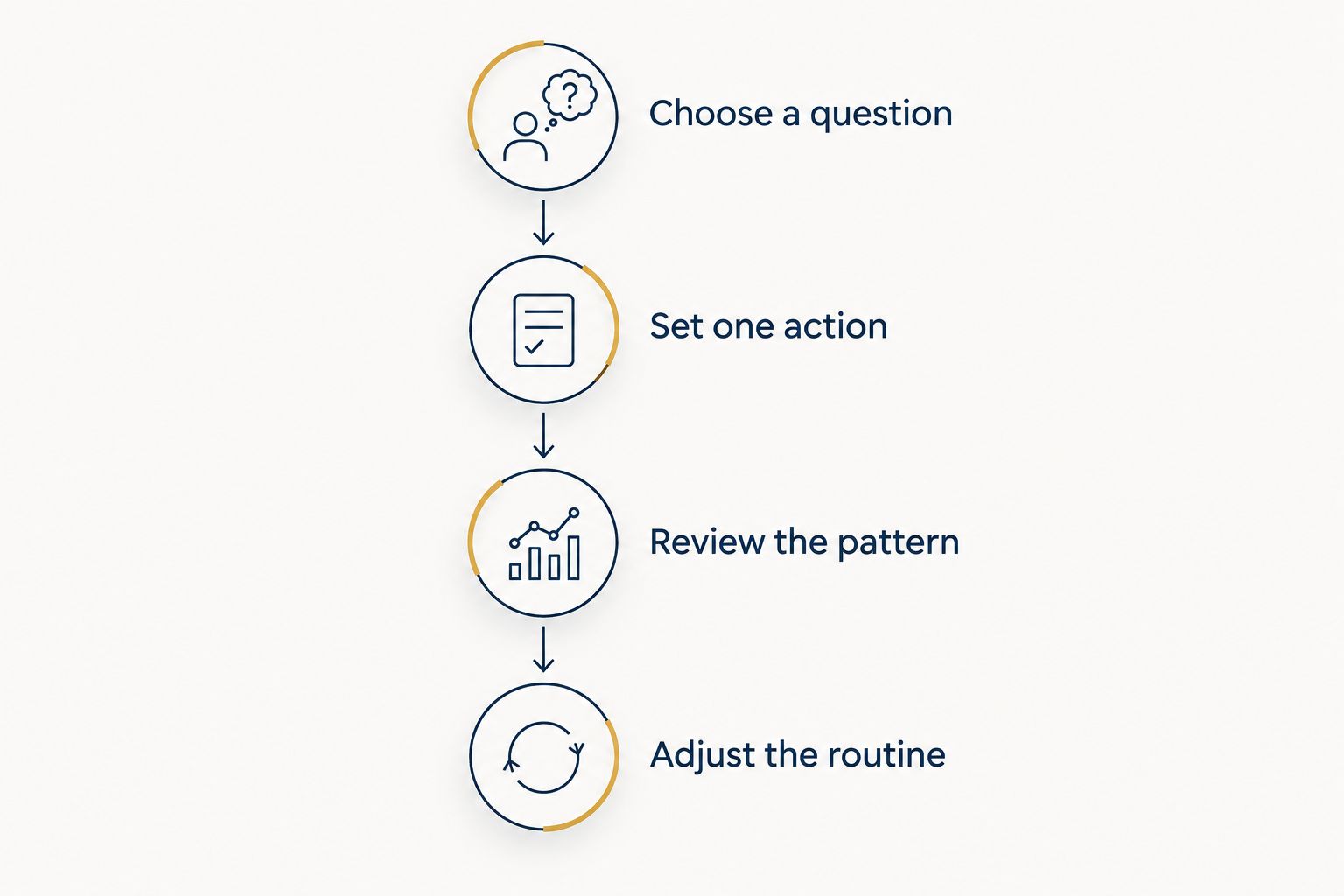
For a busy professional, the next step is not another dashboard. It is a small decision you can repeat. Use this sequence with whichever wearable you choose:
- Choose a question. Ask something practical, such as whether meeting-heavy days leave you sitting longer than you intended.
- Set one action. Pick an action that fits your calendar, such as a walk after lunch when your schedule allows.
- Review the pattern. Look across comparable days rather than judging yourself by an isolated reading.
- Adjust the routine. Keep what fits and change what repeatedly clashes with your responsibilities.
A disrupted week is information about your schedule, not a personal failure. The purpose is to make the routine easier to repeat, not to create another score you must defend.
Keep movement goals in context
U.S. Department of Health and Human Services physical activity guidelines recommend at least 150 minutes of moderate-intensity aerobic activity weekly for adults, plus muscle-strengthening activity on at least 2 days. These are general public-health guidelines, not a personalized exercise prescription or a wearable score target.
Your appropriate starting point depends on your circumstances. If you have questions about exercise safety, symptoms, or a health condition, discuss them with a qualified healthcare professional rather than using a tracker to decide.
Separate education from medical care
In 2026, a wearable still belongs alongside medical care—not in place of it. Consumer readings and app scores do not independently establish a diagnosis or tell you to change medication.
180° WELLNESS provides nurse-led wellness education and guidance with a personal approach. You can seek support with everyday wellness questions while keeping diagnosis, prescribing, and treatment decisions with the appropriate medical professional.
Take your next wellness step
Book an introductory wellness consultation for nurse-led wellness guidance.
How these fitness trackers were ranked
The ranking uses the criteria above: phone compatibility, daily friction, useful feedback, attention control, exercise fit, and comfort. Each device owns a different use case rather than competing for the same label.
This is a use-case buying guide, not a laboratory accuracy comparison or a hands-on test report. It does not rank diagnostic performance or promise health improvements from wearing a device.
For a 2026 purchase, confirm the exact model’s compatibility, features, account requirements, and support information with the manufacturer. Similar product names do not guarantee identical capabilities.
Which fitness tracker should you choose?
Choose Fitbit Charge 6 if you are undecided and want a focused everyday tracker. Choose Apple Watch Series 10 for iPhone-centered smartwatch functions, Garmin vívoactive 5 for exercise recording, or Oura Ring 4 for screen-free wear.
Keep the choice separate from the habit. A different device will not resolve a schedule that leaves no room for the action you want to take. Make that action small enough to belong in your actual workweek.
FAQ
What's the best fitness tracker for busy professionals in 2026?
Fitbit Charge 6 is this guide’s best overall choice for busy professionals seeking focused everyday activity tracking. Apple Watch Series 10, Garmin vívoactive 5, and Oura Ring 4 suit different priorities: smartwatch functions, exercise recording, and screen-free wear.
Is Apple Watch Series 10 better than Fitbit Charge 6 for work?
Apple Watch Series 10 is the better fit when you want iPhone-connected smartwatch functions alongside fitness tracking. Fitbit Charge 6 is the better fit when you want a fitness band with a narrower role.
Should I choose a fitness ring or a fitness watch?
Choose a fitness ring if screen-free wear matters more than checking information during exercise. Choose a fitness watch if you want an on-wrist display and direct access to workout recording.
Do I need a fitness tracker to become more active?
No, a fitness tracker is not required to become more active. You can plan movement around your workday without recording it; a tracker adds information, not permission to start.
Can a fitness tracker diagnose a health problem?
A consumer fitness tracker does not independently establish a medical diagnosis. Discuss concerning readings or symptoms with a qualified healthcare professional rather than relying on an app score.
What should I check before choosing a fitness tracker?
Check phone compatibility, comfort, charging needs, app requirements, and the activities you want to record. Also decide whether wrist notifications would help your workday or interrupt it.
Can I get wellness coaching outside South Florida?
180° WELLNESS offers wellness education and virtual coaching in all 50 U.S. states, with in-person services in South Florida. This availability applies to wellness guidance, not medical treatment; an introductory wellness consultation is the currently bookable next step.
One last thing
Before choosing a tracker in 2026, finish this sentence: When I review this information, I will use it to decide ______. If the answer is unclear, choose the question before the device.
You do not need a perfect score to take care of yourself. You need a next step that fits your life.