Best overall: Headspace. Best for evening wind-down: Calm. Best for exploring meditation styles: Insight Timer. The best stress management apps for professionals in 2026 fit a specific moment in your workday; Breathwrk suits breathing breaks, while Daylio suits mood and habit tracking.
- Headspace leads the best stress management apps for professionals for guided meditation with structure.
- Calm suits evening wind-down; Insight Timer suits exploring different meditation teachers and styles.
- Breathwrk focuses on breathing exercises; Daylio helps you record moods and daily activities.
- 180° WELLNESS offers nurse-led wellness education when you want personal guidance beyond a self-directed app.
Why this matters
A full calendar leaves little room for another task. Your stress management app should have a clear job: help you pause between meetings, settle into an evening routine, or notice what happens on demanding days. An app with more content is not automatically a better fit.
Start by separating self-guided practice from personal support. Apps offer exercises and records; 180° WELLNESS offers nurse-led wellness coaching and education with a personal approach. Neither wellness coaching nor a meditation app replaces medical care, diagnosis, or prescribing.
This guide ranks apps by their main functions and the workday situations they suit. It does not rank clinical effectiveness or promise a particular health result. Choose the tool you can use comfortably, not the one with the longest feature list.
What makes the best stress management app?
For this 2026 shortlist, these criteria matter more than a crowded content library:
- Clear purpose: You should know whether you are opening the app to meditate, breathe, wind down, or record your mood.
- Low setup effort: A useful practice should be easy to find when your attention is already stretched.
- Suitable guidance: Some people want spoken instructions. Others prefer a simple prompt or a brief check-in.
- Workday fit: Your choice should suit a realistic opening in your schedule, not an idealized morning routine.
- Privacy fit: Check what the app collects, what you choose to record, and how account and deletion settings work.
- Honest limits: An app should support a habit without being mistaken for individualized assessment or treatment.
Give each criterion a practical test. Open the app during the moment you actually plan to use it, rather than browsing while you have an unusually quiet afternoon. Notice whether you can reach the relevant feature without getting distracted.
Best stress management apps at a glance
| Rank and app | Best for | Standout feature | Key limitation |
|---|---|---|---|
| 1. Headspace | Building a guided meditation routine | Structured meditation courses and guided sessions | Spoken meditation will not suit every preference |
| 2. Calm | Creating an evening wind-down routine | Sleep Stories, meditation, and relaxing audio | Listening alone does not address the source of work pressure |
| 3. Insight Timer | Exploring meditation styles | Sessions from different teachers and a meditation timer | More choice requires more selection |
| 4. Breathwrk | Taking a focused breathing break | Guided breathing exercises | Breathing is a narrower tool than broader wellness support |
| 5. Daylio | Noticing mood and activity patterns | Mood entries linked with daily activities | Recording patterns does not explain their cause |
The order reflects a default starting point, not a requirement to move through every app. If you already know your main need, choose the matching row. A mood journal and a meditation app do different jobs.
1. Headspace: best stress management app for guided routines
Headspace offers guided meditation sessions and structured courses. It is the default recommendation here for professionals who want instruction rather than having to decide how to meditate on their own.
A structured format gives you something specific to return to. Instead of searching for a new technique after each difficult meeting, you can continue with a familiar practice. That makes Headspace a sensible starting point when your main obstacle is not knowing what to do.
Headspace pros:
- Guided sessions explain the practice as you go.
- Structured courses provide a sequence to follow.
- Meditation and sleep content support different daily routines.
Headspace cons:
- Spoken guidance is a poor fit if you prefer silence.
- Following sessions still requires setting aside attention.
- Guided practice does not change an unreasonable workload.
Best for: Professionals who want a clear introduction to meditation and a repeatable routine.
For your first trial, choose a consistent transition, such as the gap between ending work and starting your evening. Avoid judging the entire app from a session you attempted while answering messages.
Verdict: Buy into the routine if guided instruction helps you begin; skip it if you want tracking rather than meditation.
2. Calm: best stress management app for evening wind-down
Calm combines meditation with Sleep Stories and relaxing audio. Its clearest use case in this list is the transition away from work when you want something to listen to rather than another activity to complete.
That distinction matters if your evenings still feel like an extension of your inbox. Calm provides audio you can make part of a wind-down routine. It does not resolve unfinished work, workplace conflict, or a schedule that leaves no room to rest.
Calm pros:
- Sleep Stories provide a listening-based wind-down option.
- Meditation offers an alternative to narrative audio.
- Relaxing sound content suits people who prefer less instruction.
Calm cons:
- Audio-based routines will not suit everyone.
- Browsing for the right recording can become another distraction.
- Evening listening does not replace evaluation for persistent sleep concerns.
Best for: Professionals who want a clear boundary between the workday and bedtime.
Choose the audio before your evening routine starts. If searching keeps you engaged with your phone, select something familiar and stop browsing. The point is to step away from decisions, not create another queue to manage.
Verdict: Buy into Calm for an audio-led evening routine; skip it if your main goal is understanding mood patterns.
3. Insight Timer: best stress management app for exploring styles
Insight Timer includes guided meditation from different teachers alongside a meditation timer. It suits professionals who want to compare approaches instead of committing immediately to one teaching style.
A voice, pace, or approach that works for someone else can feel distracting to you. Insight Timer gives you room to explore that preference. The trade-off is that exploration requires decisions, which can be unwelcome at the end of a demanding day.
Insight Timer pros:
- Different teachers offer different approaches to guided practice.
- A meditation timer supports practice without continuous narration.
- Guided and self-directed options serve different preferences.
Insight Timer cons:
- Choosing among teachers takes attention.
- Session style varies, so not every recording will fit.
- Continual browsing can get in the way of repeating a practice.
Best for: Professionals who know they want meditation but have not found a preferred style.
Treat your first few sessions as a search for fit, not a search for the perfect recording. Once you find a voice or format you like, return to it. You do not need a new session every time to make the app useful.
Verdict: Buy into Insight Timer for exploration; hold off if too much choice is the reason you abandon apps.
4. Breathwrk: best stress management app for breathing breaks
Breathwrk focuses on guided breathing exercises. Its role is narrower than a meditation library: it gives you a specific breathing practice to follow during a deliberate pause.
That makes it a distinct option for someone who does not want a narrated meditation or a journal entry between tasks. Keep the exercise comfortable. Do not force deep breaths, prolonged holds, or a pace that makes you feel unwell.
Breathwrk pros:
- A focused purpose makes the intended activity clear.
- Guided exercises provide a breathing pattern to follow.
- Breathing practice offers an alternative to listening to longer narratives.
Breathwrk cons:
- Breathing exercises are not comfortable for everyone.
- A narrow focus leaves broader work and lifestyle questions untouched.
- Breath-focused attention is not the right response to every stressful moment.
Best for: Professionals who want a deliberate breathing break rather than a broader meditation program.
Try a gentle exercise while seated somewhere safe and undisturbed. Stop if you feel dizzy, uncomfortable, or more distressed; return to normal breathing. Do not practice distracting exercises while driving or operating equipment.
Verdict: Buy into Breathwrk if comfortable breathing guidance fits your breaks; skip exercises that cause discomfort.
5. Daylio: best stress management app for mood awareness
Daylio is a mood and activity journal rather than a meditation app. It lets you record how you feel alongside daily activities, giving you a record to review instead of relying only on memory.
This is useful when your question is about patterns: what your days look like, which routines you keep, and how you describe your mood. An entry records an experience. It does not prove that a particular activity caused it.
Daylio pros:
- Mood entries offer a simple check-in format.
- Activity tracking adds context to your record.
- Reviewing entries gives you specific observations to discuss.
Daylio cons:
- Entries depend on what you remember and choose to record.
- Patterns do not establish cause or provide a diagnosis.
- Tracking can become unhelpful if it turns into constant self-scoring.
Best for: Professionals who want to notice patterns before choosing which routine to change.
Keep entries brief and descriptive. Record what happened without grading yourself as successful or unsuccessful. If tracking makes you more preoccupied with every shift in mood, step back and discuss a different approach with an appropriate professional.
Verdict: Buy into Daylio for observation; skip it if you need guided practice rather than another record to maintain.
How this 2026 ranking works
Headspace ranks first because structured guidance provides a clear starting point for someone seeking a general meditation routine. Each remaining app owns a different slot: evening audio, meditation exploration, breathing practice, or mood tracking.
The ranking uses the criteria above and the apps' established functions. It is not a hands-on clinical comparison, a privacy certification, or evidence that one app produces better health outcomes than another. Review current app descriptions and privacy terms before deciding what to install or record.
Which stress management app should you choose?
Choose Headspace if you are undecided and want guided meditation. Choose another app when its specific purpose fits your need more closely. Your goal for 2026 is a usable practice, not a collection of wellness apps.
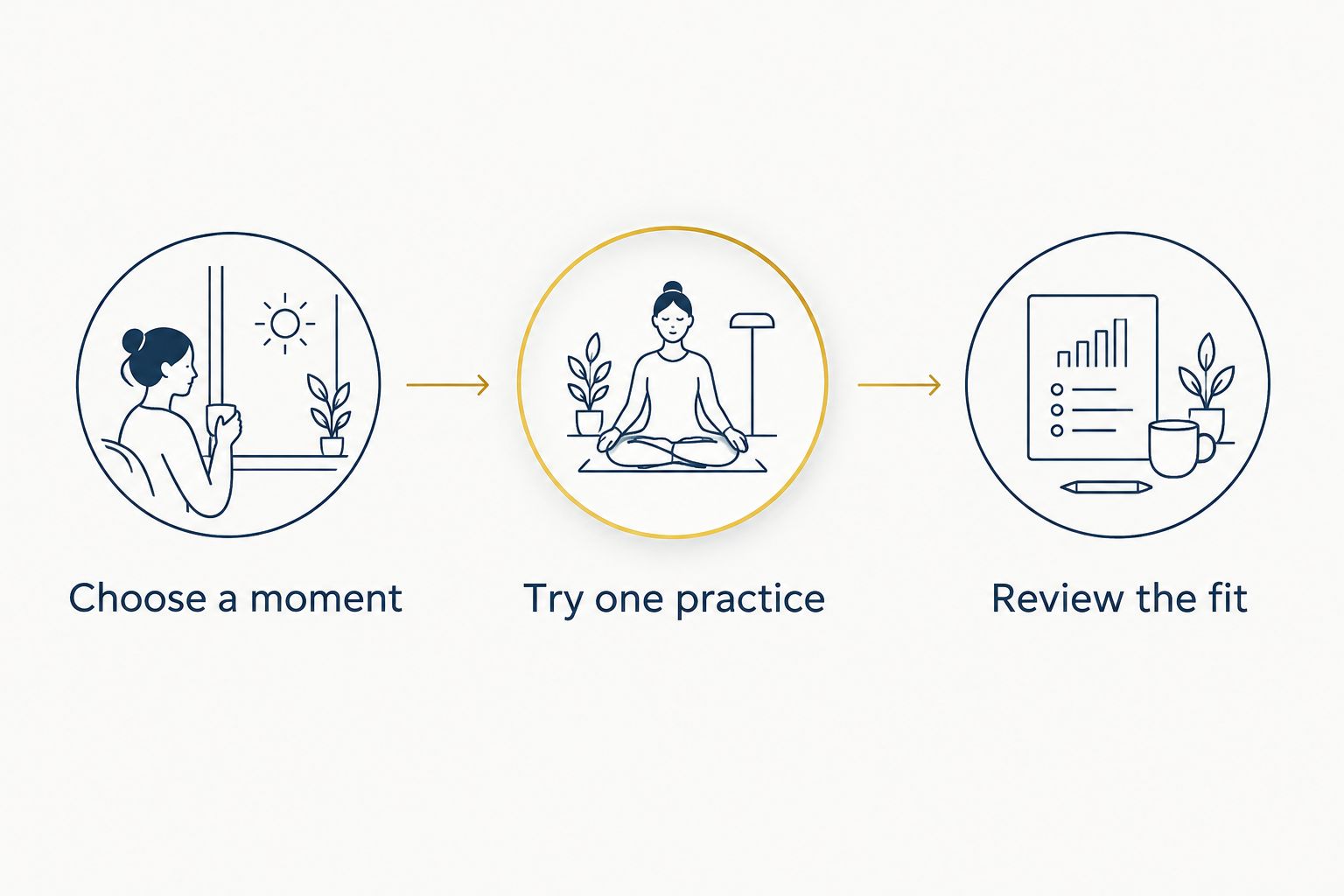
Use this simple trial before adding more tools:
- Choose a moment. Identify a real opening, such as 5 minutes after closing your workday. Put the practice there rather than expecting spare time to appear.
- Try one practice. Start with 2 minutes of a comfortable activity. This is a suggested starting point, not a required dose or a promise of results.
- Review the fit. After 1 week, ask whether the app was easy to use, suited the moment, and felt worth returning to. Change the approach if it did not fit.
An app cannot ask follow-up questions about your schedule or help you talk through competing priorities. 180° WELLNESS is best for professionals seeking nurse-led wellness education with a personal approach. Virtual wellness education and coaching are available across all 50 U.S. states, with in-person services in South Florida; this availability does not refer to medical treatment.
An introductory wellness consultation is the currently bookable next step. Ask about fit before assuming any particular ongoing service, schedule, or outcome.
Explore personal wellness support
Consider an introductory wellness consultation for nurse-led education and guidance.
FAQ
What's the best stress management app for professionals in 2026?
Headspace is this guide's default pick for professionals who want structured, guided meditation. Choose Calm for evening audio, Insight Timer for exploring meditation styles, Breathwrk for breathing exercises, or Daylio for mood tracking.
Is Calm better than Headspace for work stress?
Calm fits an audio-led evening routine, while Headspace fits a structured meditation routine. Choose according to the activity you want to repeat, rather than assuming either app addresses the cause of workplace stress.
Which app should I use during a short work break?
Breathwrk fits a break built around a comfortable guided breathing exercise. Stop any exercise that causes dizziness, discomfort, or increased distress, and avoid distracting practices while driving.
Can a mood tracking app tell me why I feel stressed?
A mood tracking app can record patterns, but it cannot establish why you feel stressed. Daylio entries can provide observations to discuss with an appropriate professional without serving as a diagnosis.
Do stress management apps replace therapy or medical care?
Stress management apps do not replace therapy or medical care. Seek a qualified healthcare professional when stress persists, disrupts daily life, or comes with symptoms that concern you.
Can I get personal wellness guidance instead of using an app alone?
180° WELLNESS offers nurse-led wellness education and coaching with a personal approach. Virtual education and coaching are available across all 50 U.S. states, with in-person services in South Florida; coaching does not replace diagnosis, prescribing, or medical care.
How should I compare stress management apps before choosing?
Compare the activity, guidance style, setup effort, and privacy settings against your actual routine. Read current app descriptions and terms, then try one clear use case rather than installing several apps at once.
One last thing
Before choosing a different app in 2026, check whether your current problem is the tool or the moment you assigned it. A meditation session scheduled during an unpredictable meeting gap has a different obstacle from a session you simply dislike.
Write down one practical sentence: after this part of my day, I will try this practice. If you want help thinking through that routine, 180° WELLNESS offers nurse-led wellness guidance. Start with a realistic next step, not a perfect plan.