Best overall: Headspace. Best for bedtime listening: Calm. Best for learning the foundations: Healthy Minds Program. This 2026 guide to the best meditation apps for beginners compares how each option helps you start, what gets in the way, and which fits a demanding workday.
- Headspace leads the best meditation apps for beginners when you want a clear, guided starting point.
- Calm suits bedtime listening; Insight Timer suits people who want to explore different teachers.
- Healthy Minds Program emphasizes learning; Medito suits straightforward guided meditation.
- 180° WELLNESS offers nurse-led wellness guidance when you want personal support beyond an app.
Why this matters
A meditation app should reduce the work of getting started, not give you another feed to manage. If you spend your break comparing teachers instead of practicing, the choice itself has become an obstacle.
For busy professionals, the useful question is simple: Which app makes your next practice easy to begin? Choose around a real opening in your day, such as the pause after lunch or the moment you finish work.
If you want personal help connecting wellness habits to your schedule, 180° WELLNESS offers nurse-led wellness coaching, education, and health guidance. An app provides recorded instruction; personal guidance gives you a conversation about your priorities. Neither replaces medical care.
What makes the best meditation apps for beginners
Use these criteria to judge the 2026 picks before choosing an app:
- Clear instruction: The guide explains what to do with your attention and what to do when it wanders.
- An obvious starting point: You can find beginner material without building your own curriculum.
- A manageable choice: The app gives you enough direction to start without endless browsing.
- A comfortable teaching style: You can listen to the voice without feeling irritated or rushed.
- A useful everyday fit: The content matches your aim, whether that is learning meditation or winding down.
- Room for repetition: You can return to a familiar practice rather than constantly choosing something new.
The best app is not necessarily the one with the biggest library. It is the one whose instructions you understand and want to use again.
Best beginner meditation apps at a glance
| Rank and app | Best for | Standout feature | Key limitation |
|---|---|---|---|
| 1. Headspace | A structured introduction | Guided beginner courses | Less suited to people who prefer choosing every practice independently |
| 2. Calm | Bedtime listening | Sleep Stories alongside meditation | Sleep content and meditation serve different purposes |
| 3. Healthy Minds Program | Understanding the foundations | Lessons paired with meditation practice | Its educational approach is not the same as a bedtime entertainment library |
| 4. Insight Timer | Exploring teachers and styles | A broad guided library and meditation timer | Choosing among many options adds work for a beginner |
| 5. Medito | Straightforward guided practice | Beginner-oriented meditation instruction | Less suited to people seeking a broad sleep-story experience |
These are distinct use cases, not interchangeable promises. Start with the row that matches your reason for downloading an app.
1. Headspace: best meditation app for a structured start
Headspace provides guided meditation and introductory courses. Its main advantage for a beginner is direction: you can follow a learning path rather than decide what meditation should look like on your own.
That makes Headspace the default 2026 recommendation if your main question is, Where do I start? Follow the beginner material before browsing for a practice to match every passing mood.
Headspace pros
- Guided instruction gives you something specific to follow.
- Beginner courses provide a clearer sequence than an open library.
- Repeating familiar guidance reduces the need to make another decision.
Headspace cons
- A course-based approach feels restrictive if you prefer independent exploration.
- You still need to find a narrator and teaching style you enjoy.
- Following a course does not remove the need to make time for practice.
Best for: You want an introduction that tells you what to try next.
Verdict: Choose Headspace for structure. Start with its beginner instruction rather than treating the whole library as your assignment. You do not need to understand every meditation style before beginning.
2. Calm: best meditation app for bedtime listening
Calm combines guided meditation with sleep-focused listening, including Sleep Stories. It fits readers whose main opening for a wellness habit comes when the workday is over and they want something to listen to while settling down.
Keep the distinction clear: listening to a story and practicing meditation are different activities. Choose Calm for the experience you actually want, not because every item in its library counts as meditation.
Calm pros
- Sleep Stories provide a listening option outside formal meditation.
- Guided meditation supports a more intentional attention practice.
- A bedtime focus gives you an obvious place to attach the habit.
Calm cons
- Bedtime entertainment does not necessarily teach meditation skills.
- Moving between stories and meditation makes it easy to lose sight of your original goal.
- Audio listening is a poor fit if you prefer a quiet, screen-free bedtime routine.
Best for: You want bedtime listening with meditation as another option.
Verdict: Choose Calm for winding down. If learning meditation is your priority in 2026, deliberately choose its meditation instruction rather than assuming bedtime listening serves the same purpose.
3. Healthy Minds Program: best for learning the foundations
Healthy Minds Program combines educational lessons with meditation practice. It suits beginners who want an explanation of the skill they are practicing, not just a voice telling them to breathe.
Choose this approach if understanding the purpose helps you engage. You can treat the lessons as preparation and the guided practice as the place to try the instruction yourself.
Healthy Minds Program pros
- Lessons give context to the meditation exercises.
- Practice and explanation sit within the same learning approach.
- Its educational focus suits readers who like understanding the reasoning behind an activity.
Healthy Minds Program cons
- Lessons add listening beyond the meditation itself.
- An educational format is not the right match if you only want bedtime stories.
- Understanding an explanation is different from becoming comfortable with practice.
Best for: You want to know what you are practicing and why.
Verdict: Choose Healthy Minds Program for learning. Do not make finishing lessons the goal. Give yourself space to try the exercises, notice what is unclear, and revisit the instruction without turning it into homework.
4. Insight Timer: best for exploring teachers and styles
Insight Timer offers guided meditation from different teachers and a timer for self-directed practice. Its strength is choice: you can explore voices and approaches instead of staying with one teaching format.
For a beginner, that freedom needs a boundary. Pick an introductory practice, listen to the opening, and decide whether the instructions make sense before searching for something else.
Insight Timer pros
- Different teachers give you room to find a voice you like.
- Guided practices support exploration of different approaches.
- The timer supports practice when you do not want continuous narration.
Insight Timer cons
- A broad library leaves more selection work to you.
- Moving between teachers introduces different language and instructions.
- A timer alone does not explain how to meditate.
Best for: You already know that teaching voice matters to you and want options.
Verdict: Choose Insight Timer for exploration. If browsing becomes the main activity, save one understandable practice and return to it. More choice is useful only when it helps you practice.
5. Medito: best for straightforward guided practice
Medito provides guided meditation with beginner-oriented instruction. It belongs on this list for readers who want to begin with meditation itself rather than make sleep listening or a large teacher marketplace the main attraction.
Use the introductory material as your starting point. Your first task is to understand the guidance, not to decide whether you are naturally good at meditation.
Medito pros
- Beginner-oriented instruction gives newcomers a place to begin.
- Guided practice provides direction when silence feels too open-ended.
- Its meditation focus suits a clearly defined practice goal.
Medito cons
- It is not the strongest match if sleep stories are your main priority.
- Recorded guidance cannot respond to your personal questions.
- A meditation-focused app still requires you to decide where practice fits in your day.
Best for: You want straightforward guided meditation without making bedtime listening your main goal.
Verdict: Choose Medito for a direct introduction. Keep the first attempt simple. Listen, follow the guidance as comfortably as you can, and leave the question of long-term commitment until you have tried it.
How these apps are ranked
The 2026 ranking prioritizes a clear starting point, understandable instruction, and a distinct everyday use case. Headspace is the default because a structured introduction directly addresses the beginner's first decision: what to do next.
Calm, Healthy Minds Program, Insight Timer, and Medito serve different preferences. Use the best-for labels as a decision tree, not a claim that one app works better for everyone's health. This is a guide to learning formats, not a clinical effectiveness ranking.
Make your first week easier
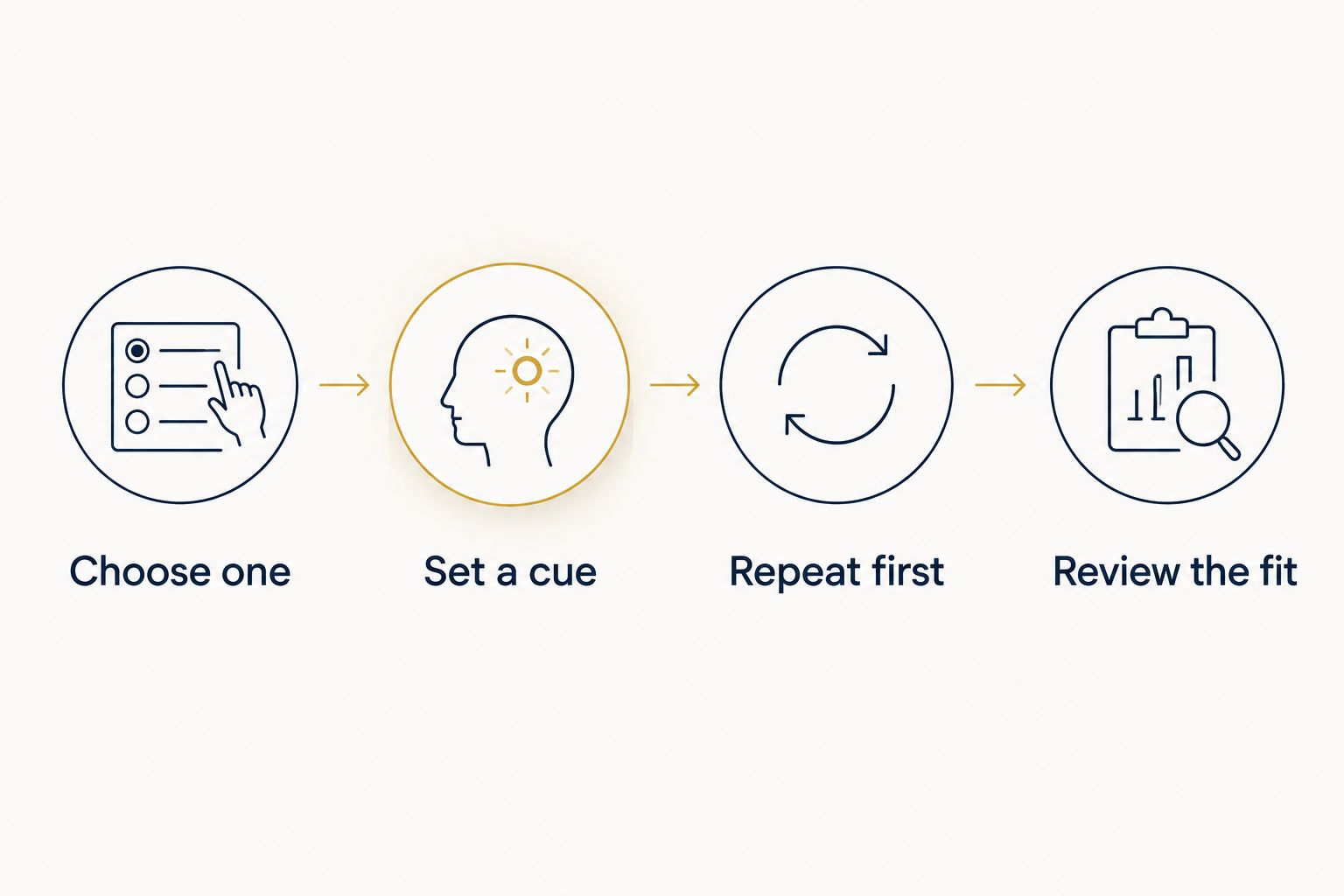
Do not turn app selection into another project. Use this suggested trial to find out whether the instructions and timing work for you.
Choose one
Choose 1 app and one introductory practice. Keep the others off your immediate to-do list so you can judge the experience without constantly comparing it with something else.
Set a cue
Attach practice to something that already happens, such as closing your work laptop. For a first attempt, set aside 2 minutes of undisturbed time; this is a scheduling suggestion, not a required meditation dose or a promise of results.
Repeat first
Try the same starting approach across 5 days before deciding whether you need more variety. Missing a day is a reason to restart at the next convenient moment, not abandon the experiment.
Review the fit
Ask whether the voice feels comfortable, the instructions make sense, and the timing fits your day. Change the part that gets in your way before deciding meditation itself is not for you.
Your calendar is useful feedback. If bedtime repeatedly fails, try a different opening rather than treating the missed practice as a personal failure.
When personal guidance is the better next step
180° WELLNESS is best for busy professionals seeking nurse-led wellness guidance with a personal approach. That is a different service from a meditation app: wellness coaching gives you a place to discuss your goals rather than choose another recording.
180° WELLNESS offers wellness education and virtual coaching across all 50 U.S. states, with in-person services in South Florida. An introductory wellness consultation is the currently bookable next step. This availability applies to wellness education and coaching, not medical treatment.
Choose personal guidance when you want a conversation about fitting wellness into your life. Choose a licensed healthcare professional for diagnosis, prescribing, or treatment questions; coaching does not replace that care.
Start with a wellness conversation
Explore nurse-led wellness guidance through an introductory wellness consultation.
FAQ
What's the best meditation app for a complete beginner in 2026?
Headspace is the default recommendation for beginners who want a structured introduction. Its guided beginner courses reduce the need to choose your own learning sequence.
Is Calm or Headspace better for beginners?
Choose Headspace for a structured meditation introduction and Calm for bedtime listening. Calm's Sleep Stories and meditation content serve different purposes, so choose according to your goal.
Which meditation app is best if I want to understand the basics?
Healthy Minds Program suits beginners who want lessons alongside meditation practice. Its educational approach gives context to the exercises rather than relying only on guided sessions.
Is Insight Timer too complicated for someone new to meditation?
Insight Timer requires more selection than a fixed beginner course, but you can keep the experience simple. Choose one introductory practice and repeat it before exploring more teachers.
Do I have to stop thinking to meditate?
No, meditation does not require you to eliminate thoughts. In attention-based practice, noticing that your mind wandered and returning to the chosen focus is part of the exercise.
Can meditation apps replace mental health treatment?
No, meditation apps do not replace assessment or treatment from a qualified healthcare professional. If a practice feels distressing, stop and discuss your concerns with an appropriate clinician.
Can I get wellness guidance without living in South Florida?
Yes. 180° WELLNESS offers wellness education and virtual coaching across all 50 U.S. states, with in-person services in South Florida. This is wellness support, not a claim of nationwide medical treatment.
Which meditation app should you choose?
Choose Headspace if you are undecided in 2026. Its structured beginner approach answers the most practical starting question: what should you do first?
Choose Calm for bedtime listening, Healthy Minds Program for explanations, Insight Timer for teacher choice, or Medito for straightforward guided practice. You do not need to download every option to make a sound decision.
One last thing
Before rating an app, try listening to the same practice again. Familiarity lets you judge the instruction without spending the session working out what comes next.
Your next move is small: choose the app that fits your purpose, decide when you will open it, and begin. You are making room for a practice, not adding another performance target.